Choosing the right early childhood environment for your toddler is one of the most consequential decisions you will make as a parent. In Gurgaon’s fast-paced educational landscape – across Golf Course Road, Sohna Road, and the DLF corridor – parents are constantly presented with competing terminologies: the traditional Playway method, the increasingly common “Montessori-inspired” preschool, and authentic Montessori preschools in Gurgaon.
While all programs promise a nurturing start, peer-reviewed developmental science paints a very different picture. Recent research demonstrates that early educational models do not merely influence kindergarten readiness – they shape cognitive architecture, emotional resilience, and psychological well-being that last well into adulthood.
To make an informed choice, parents must look past surface-level marketing and understand the real differences between Conventional Playway, Supplemented Montessori (the “Lab” model), and Authentic Montessori.
The Three Preschool Models: What the Science Actually Shows
When evaluating the Montessori vs Playway method for toddlers, most discussions reduce the choice to a simple binary. In reality, the Gurgaon preschool market consists of three distinct models:
- Model A: Conventional Playway (External Entertainment): In a conventional playway setup, the adult is the center of the room. The teacher acts as an entertainer, organizing group rhymes, coloring worksheets, and scheduled toy rotations every 20 minutes. While cheerful, this model conditions toddlers to rely on continuous adult stimulation, external praise, and frequent distraction.
- Model B: Supplemented Montessori (The “Montessori Lab” Mirage): This is the most common hybrid found in urban preschool chains. Schools set up an attractive “Montessori Lab” or activity room, but children spend 90% of their day in regular classrooms with standard plastic toys, visiting the “Lab” only for brief 30-minute demonstration slots once or twice a week.
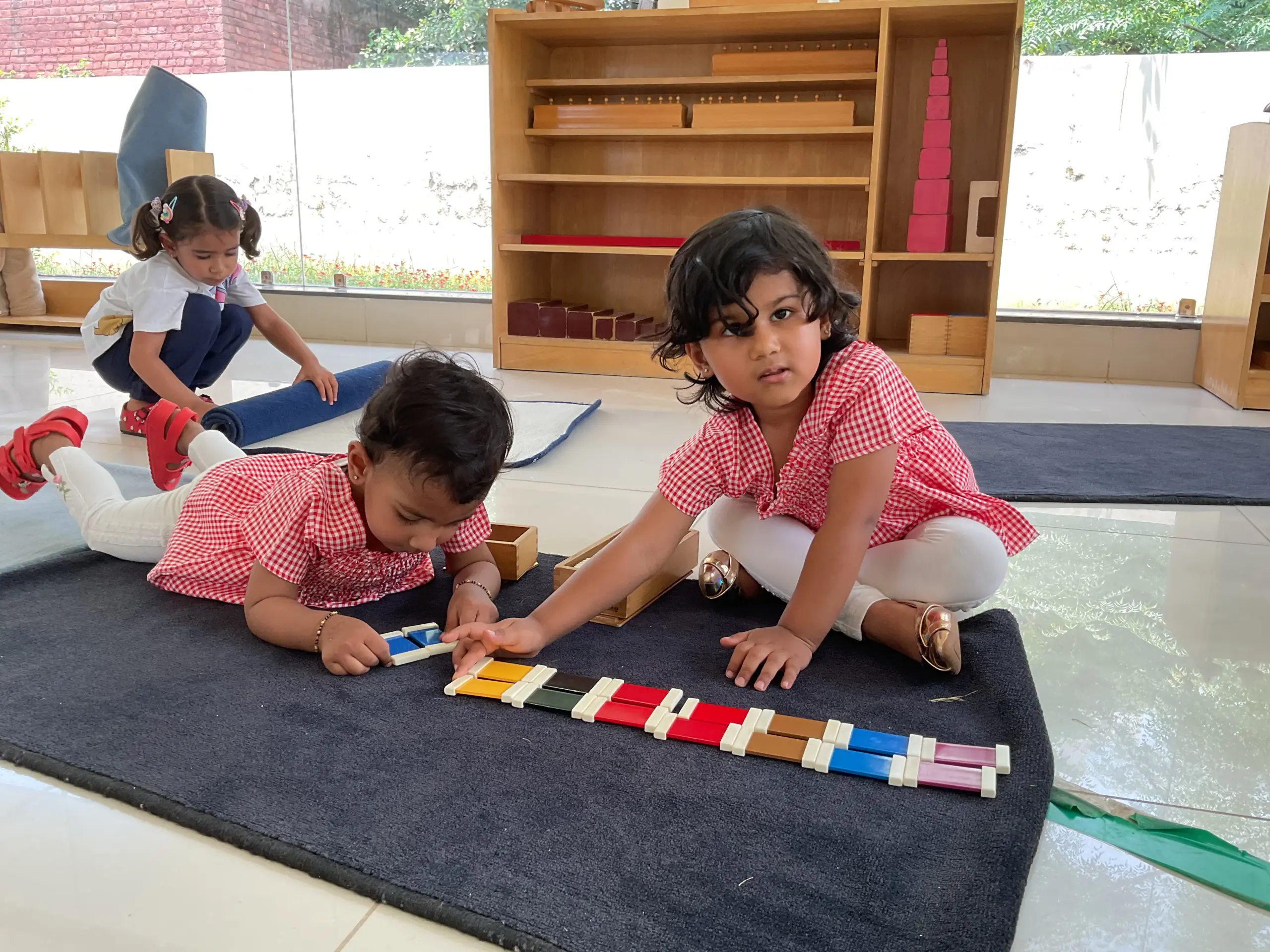
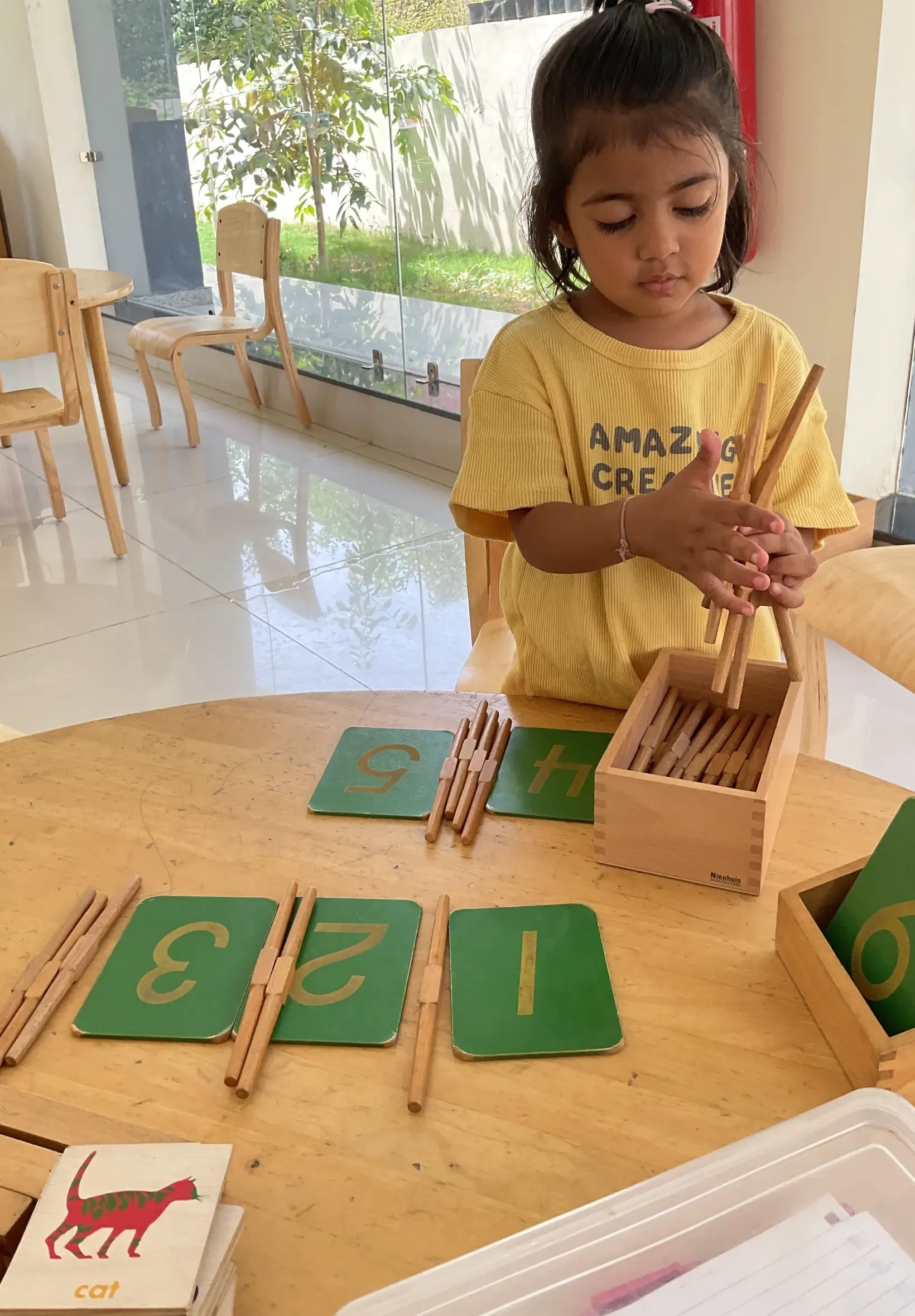
- Model C: Authentic Montessori (High-Fidelity Immersion): In an authentic Montessori community, the entire classroom is a prepared developmental environment. Children have continuous, all-morning access to a complete set of scientifically designed apparatuses, working within an unhurried, mixed-age community without artificial timetables or teacher-directed interruptions.
What Peer-Reviewed Research Reveals: The Cost of the “Lab” Mirage
Parents are often surprised to learn that mixing Montessori with conventional playway does not create a “best of both worlds.” In fact, developmental research shows the exact opposite.
Research Insight: High-Fidelity vs. Supplemented Montessori
In comprehensive studies evaluating Montessori outcomes (Lillard et al., Montessori Research and Outcomes), researchers compared children across high-fidelity (authentic) Montessori programs, supplemented Montessori programs, and conventional classrooms:
- Authentic Montessori students showed the highest developmental growth across executive function, phonemic literacy, mathematical problem-solving, and social cognition.
- Supplemented Montessori (“Lab” model) students demonstrated the lowest developmental outcomes – performing below both authentic Montessori and pure conventional classrooms.
Why does the “Montessori Lab” model fail? When children are exposed to fragmented pedagogical signals – free choice for 30 minutes in a “Lab”, followed by rigid teacher-led control in a regular room – their cognitive focus is disrupted. True executive function requires consistency, uninterrupted concentration, and daily access to self-correcting tools.
Research Insight: Lifelong Adult Well-Being (Frontiers in Psychology, 2021)
A landmark study published in Frontiers in Psychology (An Association Between Montessori Education in Childhood and Adult Wellbeing, DOI: 10.3389/fpsyg.2021.721943) surveyed adults across their lifespan and revealed a direct association: individuals who attended authentic Montessori in early childhood reported significantly higher adult psychological well-being, life satisfaction, self-confidence, and social trust.
Research Insight: Executive Control and Social Empathy (Science, 2006)
A randomized, lottery-controlled study published in the journal Science (Evaluating Montessori Education, Dr. Angeline Lillard and Nicole Else-Quest, DOI: 10.1126/science.1132362) established that 5-year-olds in authentic Montessori environments outperformed peers on executive functioning (impulse control and working memory) and demonstrated advanced Theory of Mind with positive, constructive peer conflict resolution.
The 3-Point Authenticity Checklist for Campus Tours
Criterion A: The “Montessori Lab” Mirage vs. Full-Time Classroom Integration
Ask your tour guide: “Where are the Montessori materials kept, and when do children use them?”
If the school leads you to a dedicated “Montessori Lab” or activity room that children visit for 30 minutes on specific days, this is the supplemented model shown by scientific research to produce the lowest developmental outcomes. In an authentic Montessori school, the entire classroom is the prepared environment, integrated directly inside the child’s everyday room and accessible independently at all times throughout every morning.
Criterion B: Classroom Community (Mixed-Age vs. Single-Year Batches)
Authentic environments operate as a mixed-age community spanning 1.5 to 6 years. Younger toddlers (1.5 – 3 yrs) observe older peers reading phonetic cards or solving decimal beads, absorbing advanced concepts naturally without direct instruction. Older children (4 – 6 yrs) solidify their mastery by mentoring younger peers, building deep empathy, patience, and natural leadership.
Criterion C: Shelf Quality (Imported Nienhuis vs. Plastic Replicas)
Authentic classrooms strictly eliminate plastic battery-operated toys and paper flashcards. Classrooms are exclusively stocked with world-class, premium wooden materials imported directly from Nienhuis Montessori (the official global manufacturer established in partnership with Dr. Maria Montessori) with built-in controls of error.
Summary Comparison Matrix
Discovering Authentic Montessori in Gurgaon: Productive Minds
For parents in Gurgaon who value genuine emotional well-being, scientific authenticity, and unhurried childhood over commercial marketing, Productive Minds represents the gold standard of authentic Montessori education, with campuses in Malibu Towne and Sector 65.
- Listed as the only Flagship School in Gurgaon by the Indian Montessori Foundation (IMF) – the official AMI affiliate in India
- Designed for just 42 children in a half-acre campus
- Private half-acre natural garden for unrestricted outdoor exploration
- Complete freedom with zero rigid timetables or forced transitions
- Open-house policy: children can come anytime and go anytime between 9:00 AM and 2:00 PM; parents and nannies are warmly welcome anytime
- Fully prepared mixed-age communities stocked exclusively with imported Nienhuis Montessori wooden materials
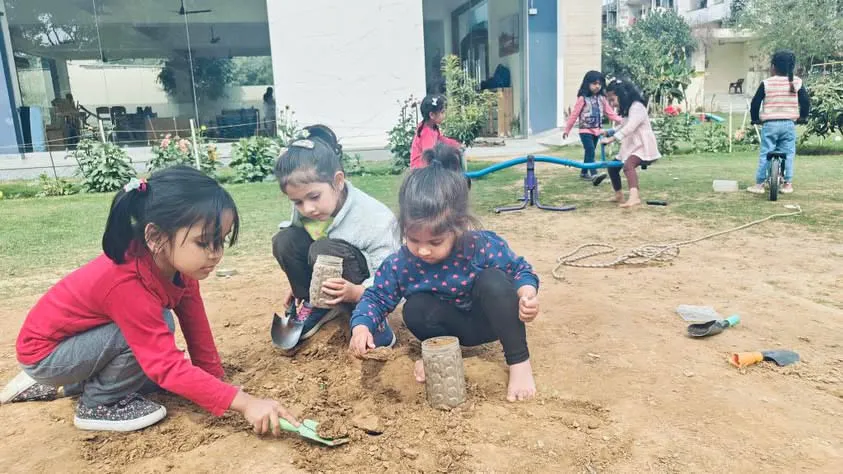
Experience Our “Two Days of Free Trial”
Brochures, websites, and sales pitches cannot convey what an authentic prepared environment feels like in person. We invite parents to experience the reality of authentic Montessori firsthand through the Productive Minds Two Days of Free Trial.
- All-Time Shelf Access: Observe the tangible difference that continuous access to imported Nienhuis Montessori materials on open shelves makes to a toddler’s focus, compared to scheduled “labs”.
- Mixed-Age Dynamics: Witness firsthand how 1.5 to 6-year-olds interact with natural harmony, mutual respect, and spontaneous peer learning.
- Deep, Calm Concentration: Experience the quiet, absorbed atmosphere of toddlers engaged in self-chosen work without teacher-led bells.
Book Your Two-Day Free Trial
Campuses: Malibu Towne (Sector 47) & Sector 65, Gurugram
Hours: Open Drop-In & Exploration from 9:00 AM to 2:00 PM (Parents & Nannies welcome anytime)
Chat on WhatsApp (+91 97119 00854)Call / Text (+91 97119 00854)